
Don’t waste money on coverage you don’t need - Here’s when to cut back

- KEY TAKEAWAYS
- Understanding car insurance in the Philippines
- Types of Car Insurance Coverage
- Coverage offered
- Legal requirements vs. Optional coverage
- Why do many Filipino car owners overpay for insurance?
- Fear-based buying decisions
- Lack of policy awareness
- Signs you’re paying for unnecessary coverage
- Low car value
- Rare usage
- When it’s smart to cut back coverage
- Aged vehicle
- Financial stability
- Coverage you might not need
- Comprehensive add-ons
- Duplicate coverage
- Risk of cutting too much coverage
- How to adjust coverage safety
- Practical tips to save without sacrificing protection
- Real-life scenarios (to cut coverage)
Let’s be honest - owning a car in the Philippines isn’t cheap. Between fuel, service & maintenance, toll fees, and insurance, your wallet takes a regular hit. But here’s the thing: many Filipino car owners are unknowingly spending more than they should on car insurance.
KEY TAKEAWAYS
How do I know if I’m overinsured?
If your premiums are high compared to your car’s value, you may be overinsured.Can I remove comprehensive insurance from my policy entirely?
Yes, you can, especially if your car is old or low-value. Just make sure you still have CTPL coverage.Is it risky to cut back on car insurance coverage in the Philippines?
It can be risky to remove essential insurance protection. Therefore, it is recommended to be strategic, not careless.Should I review my car insurance coverage yearly?
Absolutely. Your needs and your car’s value & usage change over time.What’s the best way to reduce car insurance costs?
Adjust coverage based on usage, increase deductibles, and remove unnecessary add-ons.What is one of the biggest insurance-related mistakes car owners make?
Buying car insurance coverage out of fear rather than actual need leads to overspending, which is one of the most common and biggest blunders for a car owner.Save Up to 60% on Car Insurance Renewal
- CASA Coverage Up To 10 Years Old
- Free Roadside Assistance
- Free Acts of God/Acts of Nature
 T&C
T&C
That’s exactly why understanding when it is okay to cut back on car insurance is important. You see, no car owner has to sacrifice safety to save money—you just need to be smarter about what you need and what you’re paying for.
This guide will walk you through when to trim your car insurance coverage, what to keep, and how to avoid costly mistakes.
Also Read: Car insurance FAQs updated for 2026: Essential, practical, and easy guide for drivers
So, let’s get started …
Understanding car insurance in the Philippines
Types of Car Insurance Coverage
In the Philippines, car insurance usually comes in two main forms -
- Compulsory Third Party Liability (CTPL): Required by law
- Comprehensive Insurance: Optional but widely recommended
Coverage offered
CTPL insurance includes:
- Injury or death coverage is for third-party only
Comprehensive insurance may include:
- Collision coverage
- Theft protection
- Acts of nature (like floods and typhoons)
- Personal accident coverage
Legal requirements vs. Optional coverage
CTPL is non-negotiable - it’s required for vehicle registration. Everything beyond that is up to you. It is here that many drivers overspend; they assume
More coverage = Better protection, but that’s not always true.
Also Read: Car Flooding 101: What to do and when insurance will cover the damage
Why do many Filipino car owners overpay for insurance?
There are several reasons for overpaying. Let’s discuss each in detail -
Fear-based buying decisions
Insurance agents often emphasise worst-case scenarios like accidents, theft, and floods. While these are real risks, they don’t happen to everyone.
Fear can push car owners into buying:
- Excessive add-ons
- High coverage limits
- Redundant policies
Lack of policy awareness
Let’s admit it - insurance policies can be confusing. Many people
- Don’t read the fine print
- Don’t understand exclusions
- Don’t review policies annually
All of which leads to paying for things you may never use.
Also Read: Your weekend car insurance guide: Flood, theft, & accident coverage
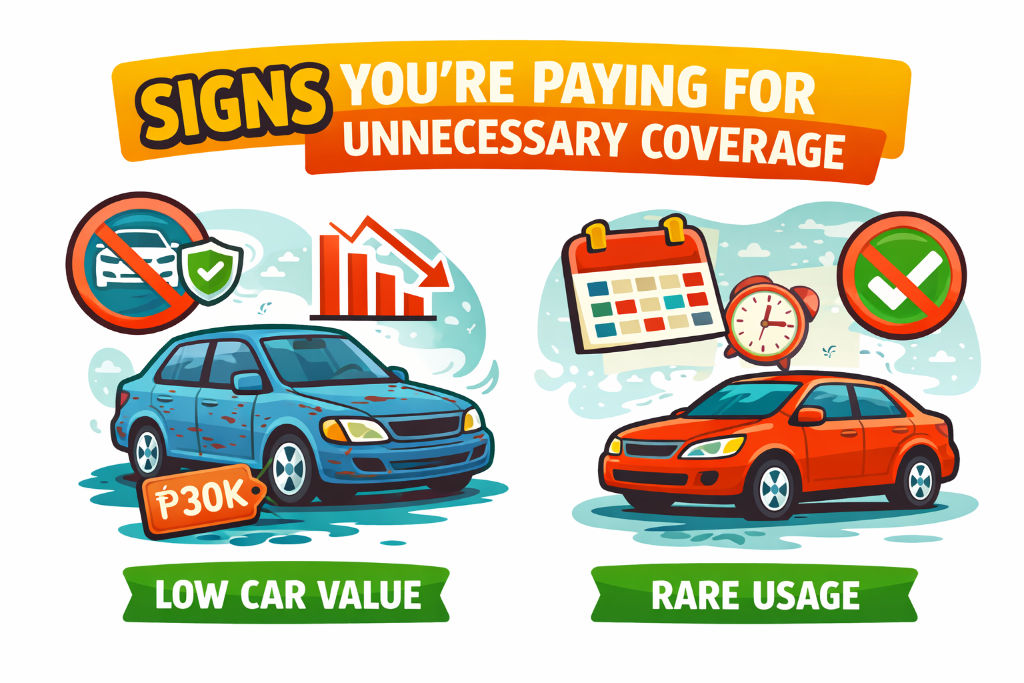
Signs you’re paying for unnecessary coverage
 AI-Generated Image
Low car value
Ask yourself: Is it still worth paying high premiums for full coverage?
If your car is more than 5 to 7 years old, its market value has significantly dropped. Note that if your car’s repairs cost more than its value, comprehensive insurance may no longer make sense.
Rare usage
Ask yourself: Do you mostly work from home? Or only use your car on weekends?
If your vehicle spends more time parked than on the road, your risk level is lower - meaning you might not need extensive coverage.
Also Read: Came back to a damaged car? Here’s how insurance helps
When it’s smart to cut back coverage
Here’s when it’s right to cut back on your car insurance coverage -
Aged vehicle
Once your car has depreciated significantly, consider the following
- Reducing comprehensive coverage
- Switching to basic protection
Financial stability
If you have emergency savings in hand, you might consider the following
- Handling minor repairs out-of-pocket
- Skipping certain add-ons
Coverage you might not need
Let us now discuss coverage options you might not use that are costing you hard-earned money.
Comprehensive add-ons
Some add-ons sound useful but are rarely used. This includes
- Roadside assistance, if you already have it elsewhere
- Personal accident coverage, if you have it covered under life insurance
- Engine protection, if you don’t drive in flood-prone areas
Duplicate coverage
There might be some coverage that you might already have through
- Credit card benefits
- Employer insurance
- Health plans
It is therefore important to check what you already have, so that you don’t end up paying twice. A good way to ensure the money doesn’t go down the drain.
Also Read: Your weekend road trip insurance checklist: 10 smart steps for a stress-free drive
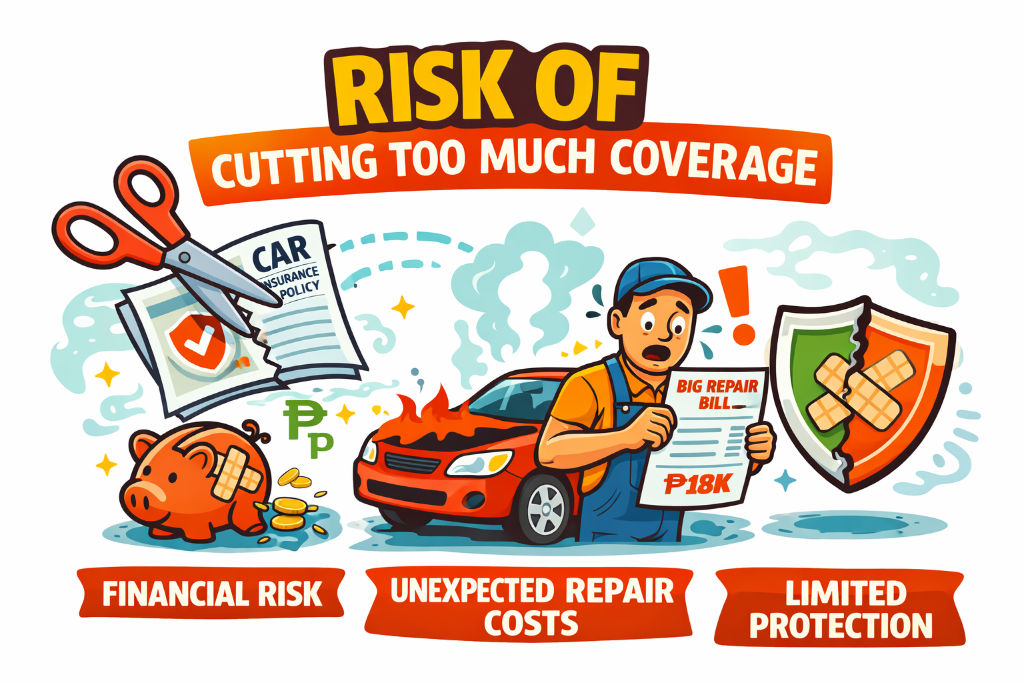
Risk of cutting too much coverage
 AI-Generated Image
- Underinsurance: Cutting too much can backfire, especially if you remove essential coverage or lower limits too drastically. The result would be that you end up paying more after an accident.
- Emergency costs: Unexpected events like floods or theft can still happen in the Philippines. Therefore, always try to balance savings with protection.
Also Read: Your weekend road trip insurance checklist: 10 smart steps for a stress-free drive
How to adjust coverage safety
Step 1: Evaluate your needs
Ask yourself:
- How often do I drive?
- Where do I usually park?
- Is my area flood-prone?
Step 2: Compare providers
Don’t settle for the first quote that you come across. It is recommended to shop around and do the following before settling: compare premiums, review coverage inclusions and exclusions, and read customer reviews.
Practical tips to save without sacrificing protection
Here are a few practical tips for car owners to save money without losing coverage -
- Increase your deductible to lower premiums
- Bundle insurance policies
- Maintain a good driving record
- Install anti-theft devices
- Review your policy annually
- Remember that small changes at your end can lead to big savings.
Also Read: How regular car maintenance can protect your insurance claims: Let’s find out!
Real-life scenarios (to cut coverage)
Scenario 1: The sedan is 10 years old. The owner can switch from comprehensive to basic coverage. Thus saving thousands of pesos annually.
Scenario 2: The owner works from home and rarely drives. In this case, coverage can be reduced and the savings used for maintenance instead.
Scenario 3: The owner realises his credit card already has accident insurance, so that the duplicate coverage can be removed.
Also Read: First-time used car buyers: 7 costly errors drivers must avoid
Bottom line
At the end of the day, smart car ownership isn’t just about driving safely—it’s also about spending wisely. The truth is, many Filipino car owners are paying for insurance they don’t really need. By understanding how to cut back on your insurance coverage, you can take control of your expenses without putting yourself at risk.
But going forward, it is essential to review your policy, cut unnecessary extras, and keep the coverage that truly protects you and your vehicle.
You see, it’s not about having the most coverage, it’s about having the right coverage.
Also Read: How dashcams can help (or hurt) your insurance claim
Featured Articles
- Latest
- Popular
You Might Also Be Interested In
- Journal
- Advice
- Financing
-
-
8th-gen Lexus ES enters PHRuben Manahan IV . Aug 10, 2026
-
Audi RS 5 Avant PHEV officially enters PHRuben Manahan IV . Aug 08, 2026
-
Ford Territory Hybrid gets new Platinum variantPaulo Papa . Aug 07, 2026
-
Toyota Motor PH to hit 3-M sales mark in 2026Aug 06, 2026
-
-
How to handle a checkpoint: The right and wrong movesCarmudi PH . Apr 14, 2025
-
-
-
-
-
Fast-track your car loan payoff with these hacksCarmudi PH . Apr 06, 2025
-
-
-
Need better auto loan terms? Here’s how to refinanceCarmudi PH . Mar 21, 2025
Featured Cars
- Latest
- Upcoming
- Popular
Car Articles From Zigwheels
- News
- Article Feature
- Advisory Stories
- Road Test
-
Mitsubishi Motors PH’s production expansion to boost contribution to local auto industryRuben Manahan IV . Aug 10, 2026
-
Major rollback set this weekPaulo Papa . Aug 10, 2026
-
Toyota partially updates GR86Ruben Manahan IV . Aug 10, 2026
-
Zigwheels weekly wrap: Aug. 3-7Paulo Papa . Aug 10, 2026
-
Mitsubishi revives VR nameplate for latest EVCesar Miguel . Aug 10, 2026
-
3 big reasons to consider the BYD Atto 2 BEVCesar Miguel . Aug 07, 2026
-
3 reasons to get excited about the MG S5 EVPaulo Papa . Aug 05, 2026
-
Check out the updated BYD Seal 5 DM-i’s strengths, weaknessesCesar Miguel . Aug 04, 2026
-
3 reasons to buy the Toyota Land Cruiser LC 300 HEVCesar Miguel . Aug 04, 2026
-
4 biggest reasons to consider the BYD Atto 2 DM-iCesar Miguel . Jul 30, 2026
-
Tips on how to prevent vehicle firesCesar Miguel . Mar 17, 2026
-
How to prepare your car for summerCesar Miguel . Mar 11, 2026
-
Avoid road trip horror stories this 'Undas' with these tipsRuben Manahan IV . Oct 20, 2025
-
Here are ways to avoid road ragePaulo Papa . Sep 23, 2025
-
How well do you understand traffic signs?Cesar Miguel . Sep 09, 2025
-
First impressions: Geely EX2Cesar Miguel . Jun 18, 2026
-
ELECTRIA: VinFast VF 6 is a well-equipped urban warriorCesar Miguel . Apr 20, 2026
-
BYD DM-i lineup conquers Southern LuzonCesar Miguel . Mar 10, 2026
-
Hyundai Creta Premium: balancing engaging drive,comfortCesar Miguel . Feb 13, 2026
-
First drive: 4th-gen Changan CS55 PlusPaulo Papa . Feb 09, 2026