
How to verify if your car insurance company is legit (Insurance Commission checklist)

- KEY TAKEAWAYS
- Common car insurance scams
- How to verify an insurance provider?
- Red flags that signal a FAKE insurer
- Red flag#1. Pressure selling
- Red flag#2. Cash-only payments
- Red flag #3. No official receipt
- Red flag#4. Vague policy details
- Insurance commission: How can you use the website efficiently
- How to verify a provider via IC’s website?
- Buying car insurance? Do ask these questions
- Why should you partner with a legit car insurance provider?
- Buying insurance online: Here are some helpful tips
Imagine getting involved in an accident, only to find out that your car insurance coverage is useless; to use a harsher word, fake. Won’t it be heartbreaking, especially after paying all that premium you paid and believing in the coverage promises?
KEY TAKEAWAYS
Should I verify both the insurance agent and provider before making a final call?
Absolutely. Make sure to do a 360-degree verification - this includes checking the agents’ and the company’s background. Often, illegal agents are caught operating in the market, selling fake policies under a genuine provider’s name.Why are some policies way cheaper compared to others?
Some insurance policies are extremely cheap. This doesn’t mean they are fake or part of a scam. When coming from a certified provider, a cheap policy indicates limited coverage, higher deductibles, or fewer benefits.How does a fake policy look real & convincing?
Scammers are way too smart; they work on creating highly convincing fake documents, and that’s why thorough verification is a must.Is it safe to buy a car insurance policy online?
Yes, absolutely. Just make sure your purchase is from a well-known, reputable, and certified provider, and that the website is verified.What to do if I suspect an insurance-related scam?
Do not panic and make hasty decisions. Rather, stay calm and inform the Insurance Commission.How to verify the legitimacy of a provider?
It can be done on the Insurance Commission website, which lists all licensed providers operating in the country.Save Up to 60% on Car Insurance Renewal
- CASA Coverage Up To 10 Years Old
- Free Roadside Assistance
- Free Acts of God/Acts of Nature
 T&C
T&C
With no one to help, you’ll have to shoulder all the car repair or replacement expenses. Not to forget the medical expenses and legal responsibilities.
So much mental and financial stress - and it all happened because you didn’t verify the provider’s legitimacy properly at the initial phase.
To help car owners avoid falling in such traps and always sign up with a genuine provider, we have created a complete checklist along with other essential knowledge that empowers you as a car owner & policyholder.
So, waste no time and read this one carefully. Starting with the common scams in the market.
Common car insurance scams
Here is a list of some of the most common insurance-related scams that car owners must watch out for -
- Unauthorised insurance providers & agents: Stay clear of individuals or providers who pretend to be legitimate. They usually offer huge discounts, use personal payment channels, use handwritten receipts, push for quick payments, and avoid one-on-one meetings.
- Fake insurance policies: This usually includes a fake company logo, forged signature, and fabricated policy number.
- Too good to be true premium & coverage combo: Remember, quality insurance comes with a cost. Such deals are nothing but a honey trap for car owners.
Also Read: Mistakes car owners make with add-ons: 7 costly errors that must be avoided
How to verify an insurance provider?
Here is a simple checklist every car owner should follow before purchasing a policy.
|
Check the provider’s license |
It is the first step -
|
|
Verify the agent |
If the company is legitimate, the agent you are dealing with must also be licensed.
|
|
Review the company’s website. |
A legitimate provider will have a secure and professional website. Always check for -
Be cautious of the website
|
|
Check the physical office location. |
A genuine provider will always have a physical office. So before finalising the deal, make sure to -
You see, scammers often avoid face-to-face meetings |
|
Official policy documents |
Before making any payment, ask for complete policy documents. Once in hand, check the following details -
A legitimate provider provides all the details, everything is ready and transparent. If that is not the case, be cautious. |
|
Check online reviews |
Reviews on Google, Facebook, Reddit, social forums, groups, etc., can reveal a lot about a company. Therefore, make sure to check out company reviews. Stay clear of the providers with patterns like -
You see, one or two complaints are okay, but repeated complaints are concerning. |
|
Confirm contact details |
Always confirm the provider's contact details. You can do so by -
If a company is reliable, you’ll get a clear and professional response. |
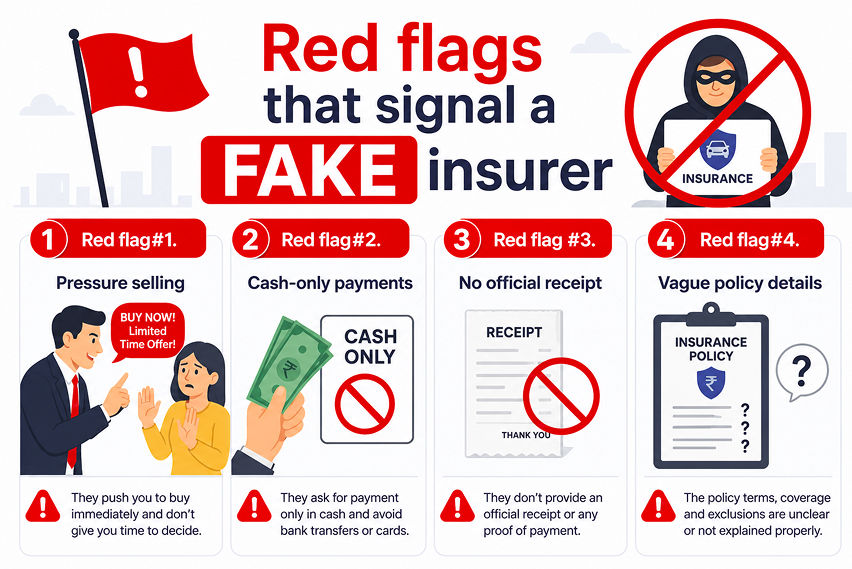
Red flags that signal a FAKE insurer
 AI-Generated Image
If you pay close attention, you'll always see some warning signs. If you act in time, you can avoid a lot of trouble. To help you, here are some warning signs to watch out for -
Red flag#1. Pressure selling
Scammers often create a sense of urgency to secure the deal quickly. So, if you hear phrases such as -
- Promo ends today
- Limited slots left
- Pay now to secure a spot
.. better be cautious, take your time, and then act. You see, legitimate providers provide customers enough time to review.
Red flag#2. Cash-only payments
Payment is a payment, it can be in cash or digital, what difference does it make? Not for a genuine provider, but definitely for a scammer. So, if your agent or seller insists on -
- Cash-only payment
- Online payments to a personal bank account or an e-wallet
… be cautious. You see, a legitimate provider will not mind bank transfers, credit card payments, or offline payment methods. All is okay with them, and is followed by a receipt.
Red flag #3. No official receipt
If a provider is hesitant to offer an official receipt, get your guards up, as there is something suspicious. If an official receipt is offered, make sure to check the following details, as smart scammers keep that handy too. Look for details like -
- Company name
- Tax details
- IC licence number
- Policy reference number
If any of this is missing, handwritten, or false, stop all transactions and verify ASAP.
Red flag#4. Vague policy details
A legitimate provider will clearly explain the policy terms, coverage, limits, deductibles, exclusions, etc., to the customer. But a fake provider would be vague, and you won't have proper knowledge of many things.
If by the end of the discussion you feel confused or inconsistent, just walk away.
Also Read: Common myths around total loss car insurance & the truth behind them
Insurance commission: How can you use the website efficiently
Every policyholder should know how to use the Insurance Commission website, as it is the best tool for verifying the provider and reaching out in case of a discrepancy.
How to verify a provider via IC’s website?
Step 1. Visit the IC’s official website
Step 2. Look for the list of licensed insurance providers
Step 3. Verify the registration status
Step 4. Confirm the contact details
You can also search for the following while at the IC website -
- Accredited agents
- Suspended companies
- Providers with revoked licences
- Contacting the Insurance Commission
If you suspect any form of scam or fraud, do not panic; contact the IC at the earliest. This government body allows policyholders to file complaints, report suspected agents, and request verification.
Also Read: Top 7 benefits of zero-depreciation car insurance for car owners
Buying car insurance? Do ask these questions
Before you sign an agreement with your future insurance partner, make sure (like 100%) to get clear answers to the following question.
Q1. Does the Insurance Commission accredit your company?
Q2. Can your IC registration be verified online?
Q3. What are the policy inclusions & exclusions?
Q4. How long does the claim usually take to get approved?
Q5. What documents are required to file a claim?
Q6. How long after the incident should I file a claim?
Q7. Are there any hidden clauses or charges?
Q8. Is there any claim limit?
Q9. Is roadside assistance included?
Q10. Is Acts of God coverage part of the comprehensive plan, or is it offered as an add-on?
Note that there is no problem in asking questions; you can do it as many times as needed. Don’t shy away; today's clarity will only add to your peace and keep your finances undisturbed.
Also Read: How regular car maintenance can protect your insurance claims: Let’s find out!
Why should you partner with a legit car insurance provider?
Having a certified car insurance provider as your partner is very important. Doing so has several benefits that further enhance the car owner's peace of mind. Here are some major advantages -
- Transparency
- Fast claim process
- Financial security
- Better customer & overall service
- Legal protection
In short, having a reliable insurance partner provides the confidence that the coverage will be beneficial when needed most. And not leave the policyholder high & dry, with all the financial burden and stress.
Also Read: How to claim CTPL Insurance? Here’s what you need to know
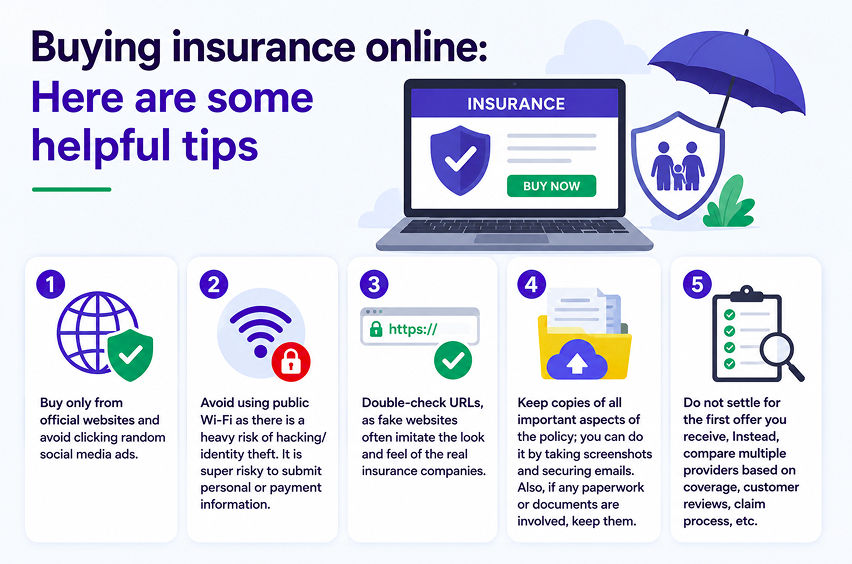
Buying insurance online: Here are some helpful tips
In this digital age, buying car insurance online is common. Car owners also prefer it for its convenience, but you need to be careful when doing so.
 AI-Generated Image
Here are some tips to help you along the way -
Tip 1: Buy only from official websites and avoid clicking random social media ads.
Tip 2: Avoid using public Wi-Fi as there is a heavy risk of hacking/identity theft. It is super risky to submit personal or payment information.
Tip 3: Double-check URLs, as fake websites often imitate the look and feel of the real insurance companies.
Tip 4: Keep copies of all important aspects of the policy; you can do it by taking screenshots and securing emails. Also, if any paperwork or documents are involved, keep them.
Tip 5: Do not settle for the first offer you receive. Instead, compare multiple providers based on coverage, customer reviews, claim process, etc.
Also Read: Does standard car insurance cover engine damage? Here’s what you need to know
Bottom line
Every car owner needs insurance to protect their car; it also provides financial protection when things go wrong suddenly. But all this will only fall into place when your insurance company is legitimate. Coz if not, you will be left empty-handed - premium paid and no payout.
How to secure yourself from such scams? Don’t worry, it’s quite simple, just follow a simple checklist and you're sorted against fake policies, insurance scams, and unauthorised agents. Here are a few tips -
- Always check the provider's license
- Review documents carefully
- Confirm the provider’s reputation before moving forward
Remember, a few minutes of research today can save you from major headaches in the future. It doesn’t matter whether you buy insurance online or from an agent; staying aware & informed is the best way to keep your car, your finances, and yourself secure.
Also Read: How SRCC coverage protects your car during civic unrest
Featured Articles
- Latest
- Popular
Recommended Articles For You
You Might Also Be Interested In
- Journal
- Advice
- Financing
-
CAMPI-TMA May 2026 YTD sales down by 12%Ruben Manahan IV . Jun 26, 2026
-
Mitsubishi PH adds new variant to Xforce rosterPaulo Papa . Jun 26, 2026
-
LC300 HEV now available at Toyota PH dealershipsRuben Manahan IV . Jun 25, 2026
-
Geely PH officially launches EX2Paulo Papa . Jun 24, 2026
-
BYD now an AVID memberRuben Manahan IV . Jun 16, 2026
-
-
How to handle a checkpoint: The right and wrong movesCarmudi PH . Apr 14, 2025
-
-
-
-
-
Fast-track your car loan payoff with these hacksCarmudi PH . Apr 06, 2025
-
-
-
Need better auto loan terms? Here’s how to refinanceCarmudi PH . Mar 21, 2025
Featured Cars
- Latest
- Upcoming
- Popular
Car Articles From Zigwheels
- News
- Article Feature
- Advisory Stories
- Road Test
-
VinEnergo to develop solar-on-water projects in PHRuben Manahan IV . Jun 26, 2026
-
Will the Kia Sportage have the same warm reception as in UK?Paulo Papa . Jun 26, 2026
-
NLEX proactively prepares for rainy seasonRuben Manahan IV . Jun 26, 2026
-
2026 TGR PH Cup to commence 2nd leg next monthCesar Miguel . Jun 26, 2026
-
Mitsubishi Motors PH makes Xforce more accessible with GLX introductionRuben Manahan IV . Jun 26, 2026
-
EDITORIAL: Mitsubishi Xforce HEV to require strong will to enter PH marketRuben Manahan IV . Jun 26, 2026
-
Denza B5: 3 reasons to buyPaulo Papa . Jun 26, 2026
-
3 reasons to like the Nissan X-Trail e-POWERCesar Miguel . Jun 25, 2026
-
Here are 3 reasons to get the Denza B8Paulo Papa . Jun 24, 2026
-
Small EV scuffle: Geely EX2 vs Dongfeng NammiCesar Miguel . Jun 24, 2026
-
Tips on how to prevent vehicle firesCesar Miguel . Mar 17, 2026
-
How to prepare your car for summerCesar Miguel . Mar 11, 2026
-
Avoid road trip horror stories this 'Undas' with these tipsRuben Manahan IV . Oct 20, 2025
-
Here are ways to avoid road ragePaulo Papa . Sep 23, 2025
-
How well do you understand traffic signs?Cesar Miguel . Sep 09, 2025
-
First impressions: Geely EX2Cesar Miguel . Jun 18, 2026
-
ELECTRIA: VinFast VF 6 is a well-equipped urban warriorCesar Miguel . Apr 20, 2026
-
BYD DM-i lineup conquers Southern LuzonCesar Miguel . Mar 10, 2026
-
Hyundai Creta Premium: balancing engaging drive,comfortCesar Miguel . Feb 13, 2026
-
First drive: 4th-gen Changan CS55 PlusPaulo Papa . Feb 09, 2026