
Top reasons Filipino drivers file Acts of Nature claims

- KEY TAKEAWAYS
- What exactly is Acts of Nature coverage?
- Top reasons drivers file Acts of Nature claims
- 1. Typhoon floods and flash floods
- 2. Fallen trees, branches, and flying debris
- 3. Volcanic ashfall
- 4. Hailstorms
- 5. Earthquakes and landslides
- Common misconceptions about Acts of Nature (AON) coverage
- Helpful tips for filing a hassle-free AON claim
Hey there, fellow driver! We all know how unpredictable driving can be in the Philippines. From sudden downpours to heavy ashfall, taking care of your beloved car is a challenge. Ask someone who has ever had to brave the flooded streets during heavy rain or Taal's ashfall, and you know exactly the nervousness one feels.
KEY TAKEAWAYS
Is Acts of Nature coverage mandatory in the Philippines?
No, it is optional. The only mandatory car insurance is Compulsory Third Party Liability (CTPL), which covers bodily injury to third parties. However, if you are financing your car through a bank loan, the bank will almost always require you to get comprehensive insurance with Acts of Nature coverage.How much does Acts of Nature coverage cost?
The cost is typically calculated as a small percentage (usually around 0.2% to 0.5%) of your car's total market value (Insured Value).Does AON cover damage caused by stray animals during a storm?
Generally, no. Damage caused by animals (like a stray dog scratching your car while running away from thunder) falls under the standard comprehensive section or accidental damage, not Acts of Nature, unless the animal was literally dropped onto your car by a tornadoCan I add AON coverage to my policy during the typhoon season?
Yes, you can request to add it to your existing policy at any time by paying a pro-rated premium. However, you cannot add it if there is already an active tropical storm warning or an ongoing disaster in your area.Save Up to 60% on Car Insurance Renewal
- CASA Coverage Up To 10 Years Old
- Free Roadside Assistance
- Free Acts of God/Acts of Nature
 T&C
T&C
Every car owner, whether a budget or premium ride, takes great care of their car. You get it serviced on time, park it in a safe & secure location, and drive defensively to avoid collisions or accidents. But no matter how careful you are, there’s one opponent you can never outsmart, and that’s Mother Nature.
In the local insurance industry, these unpredictable natural events are tagged as "Acts of Nature" (AON) or "Acts of God." And if there is one thing we Filipinos know all too well, it’s that our beautiful country gets a lot of them.
Let's dive deep into why Filipino drivers frequently file for Acts of Nature claims, what it actually covers, and how you can protect your hard-earned investment from the elements.
Also Read: Planning a beach trip soon? Learn how car insurance protects you
What exactly is Acts of Nature coverage?
A standard comprehensive car insurance policy protects you against collisions, theft, and third-party liabilities. However, it often does not automatically cover natural disasters. To get that protection, you need to include the Acts of Nature (AON) add-on.
Think of AON as your shield against events that are completely beyond human control. For instance, if a typhoon sweeps your car away or an earthquake crushes it under a concrete wall, your basic insurance won't cover the repairs, but your AON coverage absolutely will.
Given our geographic location, AON is not a luxury, but a necessity.
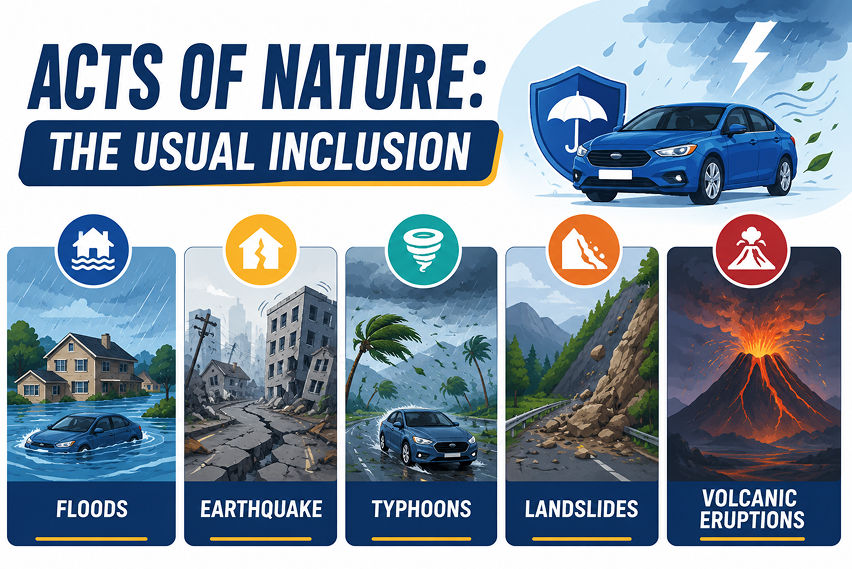 AI-Generated Image
Also Read: Acts of Nature coverage: What you need to know in 2026
Top reasons drivers file Acts of Nature claims
Every year, thousands of local car owners file AON claims. Based on industry data, here are the leading culprits behind those claims -
1. Typhoon floods and flash floods
It is impossible to discuss the Philippine weather without mentioning typhoons. With an average of 20 tropical cyclones entering the Philippine Area of Responsibility (PAR) each year, flooding is the leading cause of AON claims in the country. The annual monsoon rains usually transform the metro roads into rivers in a matter of minutes, causing the following damage.
The Damage: Floodwaters can completely ruin your car’s electrical control, damage the upholstery, cause engine hydrostatic lock (when water enters the engine cylinders), and breed mould that makes the cabin unusable.
The Victim: Obviously, the drivers living in low-lying areas are at the highest risk. However, if you live in a high-elevation area, you might find yourself trapped in a sudden flash flood while commuting to work or running errands.
Also Read: Car insurance add-ons in the Philippines: Myths, facts, and smart choices
2. Fallen trees, branches, and flying debris
Every time a severe tropical storm hits, it’s not just the water that is the culprit; the wind also has a lot of potential to cause damage. Strong winds can easily uproot old trees, snap heavy branches, and turn loose items into dangerous elements.
The Damage: A heavy tree branch falling on your car’s roof can cave in the cabin structure, shatter your windshield, and, in case the repair cost exceeds the insured value threshold, your car will be tagged as a total loss.
The Victim: Drivers with limited parking may have to park on the street or under trees. When the wind picks up, these vehicles are the ones in danger.
Also Read: Essential rights and duties every car insurance policyholder in the Philippines should know
3. Volcanic ashfall
We live in the Pacific Ring of Fire, meaning we share our islands with active volcanoes like Taal, Mayon, and Kanlaon. When volcanoes decide to wake up, a massive amount of volcanic ash drifts for dozens of kilometres.
The Damage: Don’t confuse volcanic ash with regular dust, as the former consists of tiny, abrasive particles of rock, minerals, and volcanic glass. So, if you use your wipers to clear ash off your windshield, the glass will get scratches. Furthermore, if ash gets sucked into your engine’s air intake, it can cause severe internal mechanical failure. Also, it can corrode your car's paintwork.
The Victim: Thousands of car owners living or working near areas with active volcanoes file AON claims during volcanic eruptions due to extensive paint and engine damage caused by heavy ashfall.
Also Read: What is legal assistance car insurance coverage? A must-read guide for car owners
4. Hailstorms
We know, it may sound unusual for a tropical country, but hailstorms do happen in the Philippines, particularly during the hot summer months.
The Damage: The hailstones are usually small and sudden. These ice chunk downpours can leave dozens of tiny dents across your car's hood, roof, and trunk.
The Victim: Though unusual, they are accompanied by thunderstorms and leave multiple tiny dents across a car's body. Repairing requires specialised techniques or a completely new paint job; without insurance, it can cost a fortune.
Also Read: Common roadside emergencies & coverage that will be your saviour
5. Earthquakes and landslides
Our country is susceptible to frequent seismic activity; minor tremors are common, and major earthquakes do occur, causing structural collapses. They also trigger devastating landslides, especially in mountainous regions.
The Damage: Landslides can completely bury a vehicle, while earthquakes can damage garage roofs or public infrastructure, such as flyovers, to collapse onto parked cars.
The Victim: It is the ultimate "unpredictable" event that anyone can fall prey to. Your car could be safely parked inside your garage or a building. Still, if an earthquake structurally compromises that building and damages your car, only AON coverage will save your wallet.
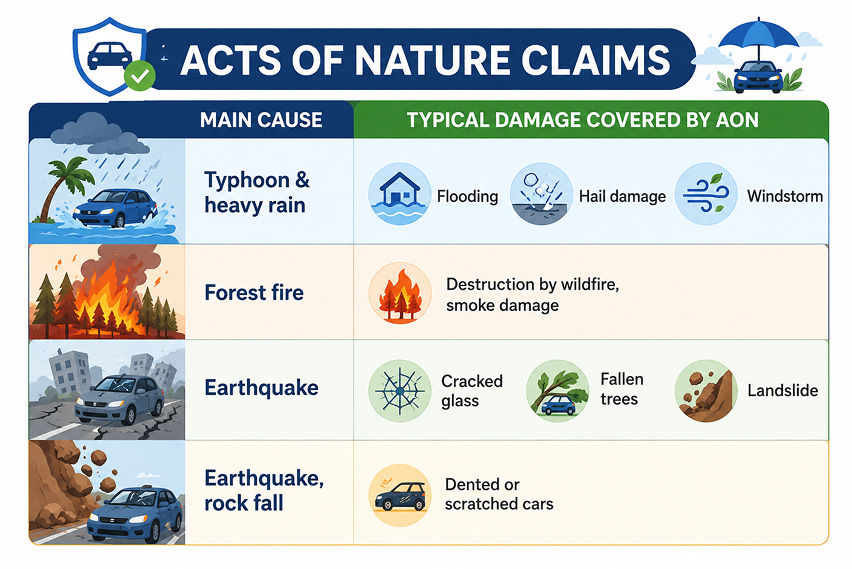 AI-Generated Image
Common misconceptions about Acts of Nature (AON) coverage
Let’s clear up a few myths that often lead to sorrow and denied claims at the insurance office -
"I have comprehensive insurance, so I’m automatically covered"
False. This is the biggest trap Filipino car owners fall into. The term "Comprehensive" sounds like it covers everything, but in the Philippine insurance landscape, it typically covers only accidents, theft, and malicious damage. It is recommended that you always check your policy's fine print to ensure that Acts of Nature or Acts of God are explicitly listed as an add-on.
"If I drive into a flooded street, my insurance will pay for it"
Not necessarily. Insurance companies closely look at intent and negligence. If your car was parked and the floodwaters rose around it, your AON claim will be approved. However, if you intentionally drove your sedan into a clearly flooded street just because you were in a rush, the insurer might deny your claim.
"AON coverage is too expensive"
False. Adding AON coverage usually increases your annual premium by only a small fraction, often just a few thousand pesos. When you compare that to the PHP 100,000+ cost of replacing a flooded engine or a ruined electronic control, the add-on pays for itself a hundred times over.
Helpful tips for filing a hassle-free AON claim
If the unthinkable happens and your car falls victim to a natural disaster, here is a quick guide to make sure your claim gets approved smoothly:
- Prioritise safety first: Never risk your life to save your car. Metal can be replaced; your life cannot.
- Document everything: Take clear photos and videos of your car in the situation, if it's safe to do so. Take photos of the damage from all angles once the disaster settles.
- Do not start a flooded engine: If your car was submerged, do not try to start it. Starting the engine can force water into the cylinders, causing catastrophic engine failure that your insurer might attribute to your actions rather than the storm itself. Rather, have the car towed straight to an authorised workshop.
- Secure a police report: Get an official document confirming that a natural disaster occurred in your area on that specific date.
- Notify your insurer immediately: Most insurance companies have a notification window (usually 24 to 48 hours). Call your agent or the hotline right away to start the process.
Also Read: Outsmart your car insurance renewal notice: 4 things to renegotiate before you sign your next policy
Bottom line
Driving is an adventure, especially on Philippine roads. From the beautiful coastal highways to the breathtaking mountain roads, it makes the perfect long-drive setup. But we also share spaces with unpredictable tropical weather and volatile geography.
Investing in Acts of Nature coverage in the Philippines isn't about being paranoid; it's about practical financial protection. It gives you peace of mind knowing that whether the sky decides to pour water, drop ice, or rain ash, your hard-earned asset is safe, and your family's mobility won't be permanently derailed.
Before the next storm warning rolls into the news, pull out your car insurance policy. Look at the fine print. If you don't see "Acts of Nature" or "Acts of God" listed there, call your insurance broker today. Trust us, your future self will thank you for it.
Also Read: The 48-hour window: A checklist for filing a car insurance claim after an accident
Featured Articles
- Latest
- Popular
-
-
-
-
Acts of Nature coverage: What you need to know in 2026Carmudi PH . May 22, 2026
-
-
Recommended Articles For You
You Might Also Be Interested In
- Journal
- Advice
- Financing
-
BYD introduces Sealion 7 in PHRuben Manahan IV . May 28, 2026
-
-
10th PIMS: 10 things to watch out forPaulo Papa . May 25, 2026
-
CAMPI-TMA Apr. 2026 sales drop by 12%Ruben Manahan IV . May 25, 2026
-
GAC PH expands lineup with Aion UT introductionRuben Manahan IV . May 21, 2026
-
-
How to handle a checkpoint: The right and wrong movesCarmudi PH . Apr 14, 2025
-
-
-
-
-
Fast-track your car loan payoff with these hacksCarmudi PH . Apr 06, 2025
-
-
-
Need better auto loan terms? Here’s how to refinanceCarmudi PH . Mar 21, 2025
Featured Cars
- Latest
- Upcoming
- Popular
Car Articles From Zigwheels
- News
- Article Feature
- Advisory Stories
- Road Test
-
Toyota Motor PH identifies models to be seen in 10th PIMSRuben Manahan IV . Today
-
Kia concept car designed using AR devicePaulo Papa . Today
-
Zigwheels PH Monthly Wrap: May 2026Cesar Miguel . Today
-
Chery Tiggo 9 CSH completes epic 12k journey from Europe to ChinaCesar Miguel . Today
-
Geely EX5 EM-i is 1st car to demonstrate ‘beyond compliance’ crash test in EuropePaulo Papa . Today
-
Let’s explore the Lexus IS’s strengths, weaknessesCesar Miguel . Today
-
Check out the 6 colors of the Geely EX5 EM-iPaulo Papa . Jun 02, 2026
-
3 reasons to buy the BYD Sealion 7 EVCesar Miguel . May 29, 2026
-
Here are the Dongfeng Vigo’s strengths, weaknessesCesar Miguel . May 27, 2026
-
3 reasons to be excited about the Toyota Land Cruiser FJCesar Miguel . May 26, 2026
-
Tips on how to prevent vehicle firesCesar Miguel . Mar 17, 2026
-
How to prepare your car for summerCesar Miguel . Mar 11, 2026
-
Avoid road trip horror stories this 'Undas' with these tipsRuben Manahan IV . Oct 20, 2025
-
Here are ways to avoid road ragePaulo Papa . Sep 23, 2025
-
How well do you understand traffic signs?Cesar Miguel . Sep 09, 2025
-
ELECTRIA: VinFast VF 6 is a well-equipped urban warriorCesar Miguel . Apr 20, 2026
-
BYD DM-i lineup conquers Southern LuzonCesar Miguel . Mar 10, 2026
-
Hyundai Creta Premium: balancing engaging drive,comfortCesar Miguel . Feb 13, 2026
-
First drive: 4th-gen Changan CS55 PlusPaulo Papa . Feb 09, 2026
-
Changan CS15: small upgrades makes the differenceCesar Miguel . Feb 06, 2026