
How to file a roadside assistance claim in the Philippines: 8 easy steps every driver should know

We’ll start with asking you a simple question: have you ever driven through busy streets like EDSA or taken a long road trip to the provinces? If your answer is yes, you know the roads are uncertain places where anything can happen at any time. For instance, you can encounter a flat tyre, an empty fuel tank or a dead battery in the middle of nowhere.
KEY TAKEAWAYS
If my car breaks down in the middle of nowhere, what shall I do?
First and foremost, stay calm. Next, turn on the hazard lights and ensure everyone's safety. Please move the car to a safe spot and contact your provider asap.How do I inform my roadside assistance about the emergency?
It is simple, just call your insurance provider/agent or the shared hotline number and register your emergency. The help should arrive soon.Is roadside assistance service offered 24/7?
Most insurance providers and third-party vendors offer round-the-clock support to the clients. However, it is a good idea to get clarity on the subject beforehand.Do I need to pay for the services offered by roadside assistance experts?
Basic services are mostly free or included in the package; however, you may get charged for off-limits jobs. It is recommended to get clarity on the subject beforehand.What information is usually required for roadside assistance claims?
You are usually required to submit your policy number, location, vehicle details, and a clear description of the issue.How long does the roadside assistance help usually take to arrive?
After contacting the provider, depending on the location, help usually arrives in 30 to 60 minutes.Save Up to 60% on Car Insurance Renewal
- CASA Coverage Up To 10 Years Old
- Free Roadside Assistance
- Free Acts of God/Acts of Nature
 T&C
T&C
It is therefore important to understand roadside assistance coverage and how to go ahead with the claim process - it is not just helpful, but extremely important.
So, if you are a Filipino car owner who wants to learn about a simple, stress-free way to handle unexpected car troubles - this guide is for you. No, this one is not just for new car owners; it can benefit even the most seasoned drivers, as knowing exactly what to do can make a huge difference.
Roadside assistance: Understanding the basics
What is roadside assistance?
Roadside assistance is an essential service that helps drivers when their vehicle breaks down unexpectedly. This coverage is either part of the car insurance policy or offered as a separate plan.
You can think of it as your perfect emergency backup plan when things go wrong on the road.
Roadside assistance providers
In the Philippines, roadside assistance is offered by -
- Insurance companies (for roadside assistance coverage)
- Car manufacturers (for brand-new vehicles)
- Third-party providers
Note that each of the above-mentioned roadside assistance providers offers different levels of services. Therefore, it is essential to understand what is included in the plan and what’s not.
Also Read: Common roadside emergencies & coverage that will be your saviour
Roadside assistance: Common services covered
Here are some of the most common services you can expect to be covered under a roadside assistance plan -
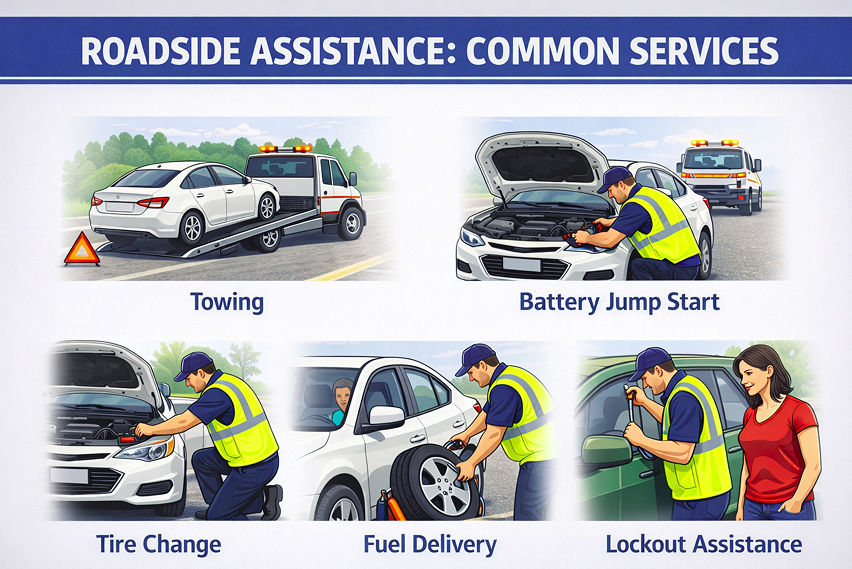 AI-Generated Image
- Towing services: If your car breaks down, this service will help tow your vehicle to the nearest repair shop.
- Battery jumpstart: If your car’s battery dies unexpectedly, this service will come to you and help revive the setup.
- Flat tyre assistance: This service helps you replace a flat tyre with a spare.
Fuel delivery: When you run out of gas, this service delivers fuel to your location. - Lockout assistance: If you have accidentally locked yourself outside, this service will send an expert to help you save your day.
Overall, roadside assistance services save you from several stressful and sometimes even dangerous situations.
Also Read: Your weekend road trip insurance checklist: 10 smart steps for a stress-free drive
Why every car owner needs roadside assistance
We aren’t exaggerating when we say driving in the Philippines is no piece of cake and comes with its own challenges. On top of the list are -
- Heavy traffic
- Flash floods
- Limited access to mechanics (especially in remote areas)
- Poor traffic sense
Amid all this trouble, having roadside assistance provides peace of mind. As long as you are, help is just a call away. Remember, it is not just about convenience, it’s about being prepared.
Also Read: Car insurance add-ons in the Philippines: Myths, facts, and smart choices
Filing roadside assistance claim: Step-by-step guide
Step 1: Stay calm & ensure safety
The moment your car breaks down, your first instinct might be panic, but not with roadside assistance - as this coverage ensures you & your car keep moving. But before help arrives, it is crucial to stay calm and do the following -
- Turn on the car’s hazard lights
- If possible, move the vehicle to the side
- Place the warning triangle behind the car (approx. 50 to 100 meters behind) to ensure safety.
Remember. Safety should always be prioritised.
Step 2: Assess the situation
After ensuring your passengers' and your safety, it is time to calmly assess the problem - what exactly went wrong with the vehicle.
Here are the most common checkpoints
- Tyre, is it flat?
- Engine, did the car stop suddenly?
- Battery, is the unit dead?
Performing these checks will help you clearly communicate the issue to your service provider.
Step 3. Collect important information
Before you reach for your phone to call your service provider, gather the following essential information. Why? Because you might be asked to share them on a call, it’s better to be prepared.
- Insurance policy or membership number
- Car details like make & model
- Car’s plate number
- Exact location
- Description of the issue
Having all this information ready significantly speeds up the process.
Step 4: Contact your provider
Time to call your roadside assistance provider or agent immediately. Most providers offer support like -
- 24/7 hotline number
- Mobile application
- SMS & chat service
Tip: Save your provider’s/agent’s contact number in your phone before you even need it.
Step 5: Clearly explain the issue & whereabouts
When on call with your provider, try to be as specific as possible. Describe the issue and your location as clearly as possible. It will allow help to reach quickly and be well-equipped.
Remember, clear communication ensures the right type of assistance reaches you on time.
Step 6: Follow instructions carefully
During the call, the operator may ask you to perform some simple troubleshooting; please do so for the safety of your vehicle. Also, you should stay in a safe location and, if possible, move the vehicle. Honour the shared arrival time; don’t pester the operator repeatedly.
Step 7: Wait for assistance
While the help arrives, make sure to -
- Stay inside the car
- Keep your phone charged and accessible
- Avoid accepting help from an unknown
Remember, patience is the key.
Step 8: Verify & confirm the provider/operator
Once the help arrives, make sure to do the following -
- Firstly, on arrival, confirm the service provider’s identity
- Next, check the service performed
- Lastly, sign any document if needed
Tip: Make sure to ask for a receipt or any sort of confirmation for your records.
Also Read: Your weekend car insurance guide: Flood, theft, & accident coverage
Real-life scenarios
Scenario 1: Flat tyre in Manila
You are driving through Metro Manila traffic and all of a sudden the car wobbles - it’s a flat tyre!
What to do? Call your provider, share your location, and request their assistance.
Scenario 2: Dead battery in a mall parking lot
You went to the mall for some shopping, but didn’t get back home on time because the car wouldn’t start.
What to do? This one is a battery issue; call the provider and request a battery jumpstart.
Scenario 3: Engine trouble in a province
You are on a road trip with your family and the engine stalls.
What to do? If the car won’t start, call the provider and request towing to the nearest accredited repair shop.
Also Read: Office parking risks - and the insurance that covers them
Tips for fast claim approval
 Photo from Freepik
Want things to go smoothly? Make sure to do the following -
- Keep your policy active
- Always carry a copy of your policy
- Double-check your coverage limits
- Save the provider's contact details
- Use verified/official channels
Common mistakes to avoid
As a car owner who wants to protect their car, passengers, and themselves. Plus, if you want to enjoy a hassle-free claim process, make sure to stay clear of the following mistakes -
- Not knowing your insurance policy, coverage, and limits very well
- Providing inaccurate location details to the operator
- Not being clear on the facts related to the issue or damage
- Contacting unauthorized mechanics
- Ignoring safety precautions
Also Read: Common insurance myths Filipino drivers still believe in 2026
Bottom line
Having roadside assistance coverage is one thing, and knowing how to use it is another. In this article, we have discussed the steps to file a roadside assistance claim, giving you control in unexpected situations. So, no more panicking, only clarity of the action plan.
Why are we stressing this so much? Well, that’s because emergencies are unpredictable, especially when out on the road, and it’s your response that makes all the difference. All that is needed is right preparation, a clear understanding of the process, and a reliable provider by your side - and you are equipped to handle any roadside issue with confidence.
So, the next time you head out in your car, take a few minutes to review your insurance plan, save important contacts, and keep this guide in your mind. Doing so will prepare you well, and that’s what makes all the difference.
Also Read: Difference between basic car insurance and add-ons: Insights for Filipino drivers
Featured Articles
- Latest
- Popular
Recommended Articles For You
You Might Also Be Interested In
- Journal
- Advice
- Financing
-
-
Audi RS 5 Avant PHEV officially enters PHRuben Manahan IV . Aug 08, 2026
-
Ford Territory Hybrid gets new Platinum variantPaulo Papa . Aug 07, 2026
-
Toyota Motor PH to hit 3-M sales mark in 2026Aug 06, 2026
-
GAC Int’l PH officially launches new MPV familyPaulo Papa . Jul 30, 2026
-
-
How to handle a checkpoint: The right and wrong movesCarmudi PH . Apr 14, 2025
-
-
-
-
-
Fast-track your car loan payoff with these hacksCarmudi PH . Apr 06, 2025
-
-
-
Need better auto loan terms? Here’s how to refinanceCarmudi PH . Mar 21, 2025
Featured Cars
- Latest
- Upcoming
- Popular
Car Articles From Zigwheels
- News
- Article Feature
- Advisory Stories
- Road Test
-
Mitsubishi Motors PH’s production expansion to boost contribution to local auto industryRuben Manahan IV . Today
-
Major rollback set this weekPaulo Papa . Today
-
Toyota partially updates GR86Ruben Manahan IV . Today
-
Zigwheels weekly wrap: Aug. 3-7Paulo Papa . Today
-
Mitsubishi revives VR nameplate for latest EVCesar Miguel . Today
-
3 big reasons to consider the BYD Atto 2 BEVCesar Miguel . Aug 07, 2026
-
3 reasons to get excited about the MG S5 EVPaulo Papa . Aug 05, 2026
-
Check out the updated BYD Seal 5 DM-i’s strengths, weaknessesCesar Miguel . Aug 04, 2026
-
3 reasons to buy the Toyota Land Cruiser LC 300 HEVCesar Miguel . Aug 04, 2026
-
4 biggest reasons to consider the BYD Atto 2 DM-iCesar Miguel . Jul 30, 2026
-
Tips on how to prevent vehicle firesCesar Miguel . Mar 17, 2026
-
How to prepare your car for summerCesar Miguel . Mar 11, 2026
-
Avoid road trip horror stories this 'Undas' with these tipsRuben Manahan IV . Oct 20, 2025
-
Here are ways to avoid road ragePaulo Papa . Sep 23, 2025
-
How well do you understand traffic signs?Cesar Miguel . Sep 09, 2025
-
First impressions: Geely EX2Cesar Miguel . Jun 18, 2026
-
ELECTRIA: VinFast VF 6 is a well-equipped urban warriorCesar Miguel . Apr 20, 2026
-
BYD DM-i lineup conquers Southern LuzonCesar Miguel . Mar 10, 2026
-
Hyundai Creta Premium: balancing engaging drive,comfortCesar Miguel . Feb 13, 2026
-
First drive: 4th-gen Changan CS55 PlusPaulo Papa . Feb 09, 2026