
Pickup Sangla OR/CR for Personal and Business Use: Requirements and What to Expect

A pickup generally has two purposes: being used as a family car on Sundays and making the supply run on Mondays, which is why lenders want to know how you use it. The basic sangla OR/CR requirements are the same for all pickups, namely the original OR/CR in your name, valid identification, proof of income, and proof of residence. The difference between personal and business use lies in the method you use to prove your income and in the additional documents you have to provide. The following is a list of what you should prepare so that you can compare lenders having a full file.
Is Your Pickup Eligible?
Lenders check the same basics on almost every pickup:
- The model year has a minimum requirement; for instance, Asialink Finance will accept vehicles that are from 2011 or more recent for its Sangla OR/CR product.
- Make sure that the documents are in your name or you have a Notarized Deed of Sale document to prove ownership. If you still have payments left to make on the truck, first read the question 'Can I apply for a Sangla OR/CR if I haven't yet finished paying off my car loan?'
- The condition and the mileage; used work trucks display the effects of their use, and it is the condition and the mileage that determine the price to an appraiser.
- There is strong demand for second-hand vehicles, since popular pick-ups retain their value nicely, aiding the valuation process. The guide on the Toyota Hilux Sangla OR/CR deals in full detail with the most typical situation.
Requirements for Personal-Use Pickups
Since your main purpose for using the service is to pick up family members and for commuting and you have a salary, you can expect the following list, which is based on Carmudi's published requirements:
- Two valid government-issued IDs
- A copy of the vehicle's OR/CR
- Proof of income for the last three months (payslips, Certificate of Employment, or bank statements)
- Proof of residency, such as an electric or water bill
The eligibility criteria set out by Carmudi apply to Filipino borrowers who are between the ages of 21 and 65 and who have a documented income. In the case where a co-borrower is required, this person must be an immediate family member (deviation will be subject to lender’s discretion) and also fall within the age range of 21 to 65 with a documented income. The complete list of requirements regarding OR/CR as specified in our Sangla OR/CR requirements checklist is available for all types of vehicles.
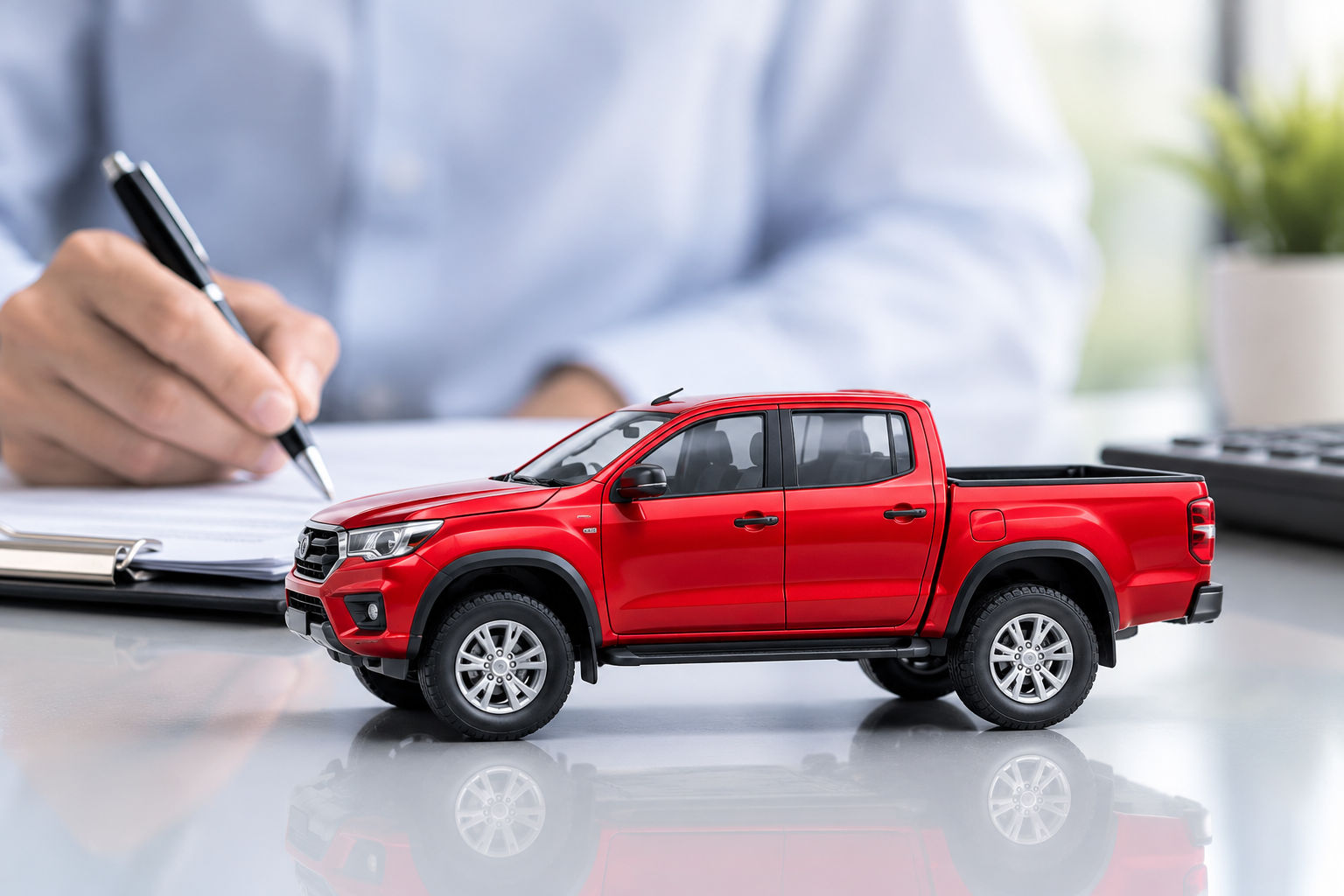 AI-generated image
Extra Requirements for Business Use
When your income is derived from a business and the pickup applies to that situation, you should prepare the same documents as an employed applicant together with your business papers. The refinance page on Carmudi lists these documents for business owners:
- DTI registration (for sole proprietors)
- Business permit
- SEC registration papers (for corporations and partnerships)
- General Information Sheet (GIS)
- Audited financial statements (AFS)
The situation is straightforward in that if you don't have a payslip the lender will obtain your income from your business records and your latest Income Tax Return (ITR): BIR Form 1701 for sole proprietors, or Form 1702 for corporations and partnerships. It's important that the name on your ID, the OR/CR, and the documents relating to your business all match, since discrepancies in these areas are a frequent reason for delays.
Are you still having financing from a bank? Generally speaking, a vehicle which is still being financed is not eligible for a standard sangla since the OR/CR must be free of any charges. However, some financing companies do consider takeout arrangements, consisting of them paying off the original loan and then refinance the remaining balance, so it's worth asking before you dismiss this option.
If the vehicle is registered in a company's name, then Carmudi's eligibility criteria, which are stated for individual borrowers including those who provide business documentation, may not apply. You should check with the lender or Carmudi's customer service before making an application. You can expect to be asked for the company's registration documents and evidence that the person signing is authorised to act on behalf of the company, although the specific documents required will differ from lender to lender.
Personal vs. Business Use at a Glance
|
Personal use |
Business use |
|
|
Income proof |
Payslips, COE, or bank statements (3 months) |
Bank statements, business records, and ITR (BIR Form 1701/1702) |
|
Core documents |
2 valid IDs, OR/CR, proof of residency |
Same, plus DTI/SEC, business permit, GIS, AFS, ITR |
|
What lenders read |
Employment and monthly income |
Business income and paperwork consistency |
|
Watch out for |
Name mismatch, existing lien |
Name mismatch across documents, company-registered units |
When you make Carmudi vehicle refinancing enquiries, be sure to include information about your current vehicle ownership and usage.
How Business Use Can Affect the Appraisal
The amount of daily use is reflected in the mileage, the condition of the vehicle's body, and its mechanical state, all of which affect the assessed value that is used to determine your loan. Even if a work truck has been well looked after it can still obtain a strong appraisal, but one that is worn will not. The appraiser will also check that the engine and chassis numbers match those on your OR/CR, so it's important to keep the vehicle clean and have the documentation ready. To find out how Carmudi's refinance process works throughout the entire procedure—from applying to the credit check, any necessary inspection, and the release of the funds—please see Carmudi's step-by-step refinance process.
What Amount Can You Expect?
Your loan is a percentage of the appraised value, not the full figure. Carmudi's refinance page advertises up to ₱10 million in cash, with approval in 2 to 3 business days after the credit check. SB Finance's Car4Cash program, as another benchmark, offers up to ₱2 million against an OR/CR, with add-on rates from about 1.25% per month, terms up to 36 months (48 months for larger loans), and a processing fee of roughly 3.5%. These are ceilings, and final amounts depend on your pickup and the lender. Terms of up to 48 or 60 months are typical for heavy truck financing, so ask your lender what tenure it offers for your pickup. If the loan is meant to ease business cash flow, test the monthly payment against your income with Carmudi's EMI calculator before you commit. We explain the math in How Much Can You Borrow Against a Fully Paid Car?
Common Reasons Pickup Applications Stall
- The OR/CR is not under the applicant's name and there is no Deed Of Sale
- An existing lien or an unfinished auto loan
- Missing business papers, or names that do not match across documents
- Engine or chassis numbers that do not match the OR/CR
- Income that cannot be shown on paper
Prepare, Compare, Apply
- Confirm the OR/CR is under your name and carries no lien.
- Decide whether you apply as an employee or as a business owner, and gather the matching documents.
- Take clear photos of the pickup, including the odometer.
- Get more than one quote, and compare effective cost, not just the loan amount. Our guide to comparing car refinancing offers shows how.
- Use your pickup details to check pickup refinancing eligibility with Carmudi.
Final Word
It makes no difference whether it's for personal or business use—the requirements are the same: a clean OR/CR in your name, valid identification, proof of income, and proof of residency. For business use, more paperwork is required and the income check has to be based on your business records. Make sure you have the correct documents before applying, check the details with the lender if the pickup is registered to a company, and only borrow the amount that you can repay without difficulty. The interest rates and credit limits will differ from one lender to another and are subject to approval.
Also read: Sangla OR/CR Car Requirements in the Philippines: Complete Checklist
Featured Articles
- Latest
- Popular
-
-
-
How Much Can You Borrow Against a Fully Paid Car?Carmudi PH . Oct 06, 2026
-
-
-
-
-
-
-
How Much Can You Borrow Against a Fully Paid Car?Carmudi PH . Oct 06, 2026
-
-
Recommended Articles For You
-
-
How Much Can You Borrow Against a Fully Paid Car?Carmudi PH . Oct 06, 2026
-
-
-
You Might Also Be Interested In
- Journal
- Advice
- Insurance
Featured Cars
- Latest
- Upcoming
- Popular
Car Articles From Zigwheels
- News
- Article Feature
- Advisory Stories
- Road Test
-
Denza to launch God’s Eye in Europe for Z9 GT, but what about PH?Cesar Miguel . Oct 15, 2026
-
NLEX-C5 Northlink Section nears completionRuben Manahan IV . Oct 15, 2026
-
GAC introduces Aion UT CrossCesar Miguel . Oct 15, 2026
-
Bentley Torcal lights up ManhattanPaulo Papa . Oct 15, 2026
-
Audi Q7 scores 100% in Euro NCAP post-crash safety categoryCesar Miguel . Oct 15, 2026
-
3 reasons to buy the all-new Lexus ESCesar Miguel . Oct 09, 2026
-
5 exciting things about the Kia EV3Paulo Papa . Oct 09, 2026
-
iCAUR V27: 1st lookPaulo Papa . Oct 02, 2026
-
iCAUR V23: 1st impressionsPaulo Papa . Oct 01, 2026
-
3 reasons to be excited about the iCAUR V27Cesar Miguel . Sep 25, 2026
-
Weighing down on car parkingPaulo Papa . Sep 24, 2026
-
Tips on how to prevent vehicle firesCesar Miguel . Mar 17, 2026
-
How to prepare your car for summerCesar Miguel . Mar 11, 2026
-
Avoid road trip horror stories this 'Undas' with these tipsRuben Manahan IV . Oct 20, 2025
-
Here are ways to avoid road ragePaulo Papa . Sep 23, 2025
-
Sedan supremacy: Toyota Corolla Altis GR-S HEVPaulo Papa . Aug 27, 2026
-
First drive: Kia Sportage Turbo HybridCesar Miguel . Aug 18, 2026
-
First impressions: Geely EX2Cesar Miguel . Jun 18, 2026
-
ELECTRIA: VinFast VF 6 is a well-equipped urban warriorCesar Miguel . Apr 20, 2026
-
BYD DM-i lineup conquers Southern LuzonCesar Miguel . Mar 10, 2026